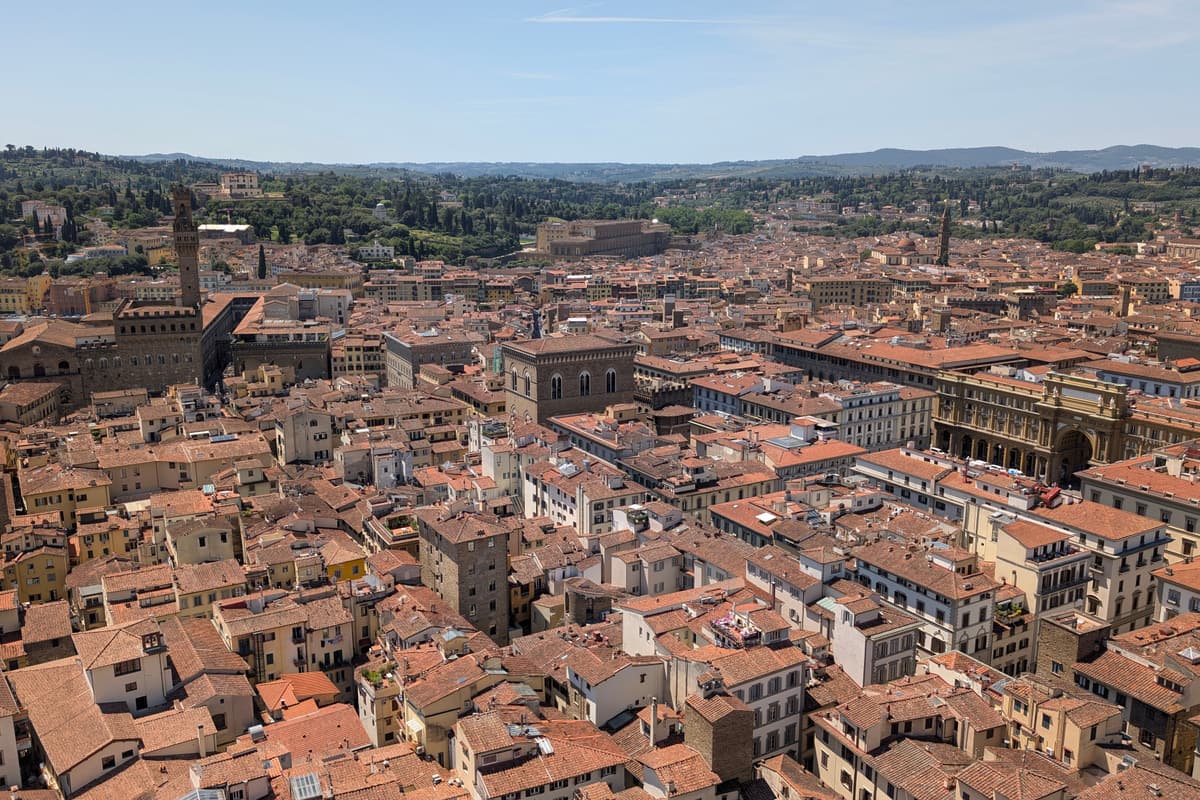
Palazzo Pitti — the Pitti Palace — is the vast Renaissance palace on the Oltrarno, the south bank of the Arno, a few minutes' walk from the Ponte Vecchio. It was begun in 1458 for the Florentine banker Luca Pitti, a rival of the Medici, but the family's fortunes faltered and in 1549 Eleonora di Toledo, wife of Cosimo I de' Medici, bought it to be the new grand-ducal residence. For nearly four centuries it remained the home of those who ruled Florence and Tuscany: the Medici, then the House of Habsburg-Lorraine from 1737, and finally the House of Savoy after Italian unification, who used it as a royal palace. King Victor Emmanuel III gave the palace and its collections to the Italian state in 1919.
Today the palace is the largest museum complex in Florence, and a single named ticket opens seven collections under one roof. The centrepiece is the Palatine Gallery: around 500 paintings hung across the grand state rooms in the dense seventeenth-century 'quadreria' style — covering the walls floor to ceiling, arranged by the personal taste of the grand dukes rather than by date or school. It holds the largest concentration of works by Raphael anywhere in the world, alongside paintings by Titian, Andrea del Sarto, Tintoretto, Caravaggio and Rubens. Beyond it lie the Imperial and Royal Apartments, the Gallery of Modern Art, the Museum of Costume and Fashion, the Treasury of the Grand Dukes (the Tesoro dei Granduchi), the Museum of Russian Icons, and the Palatine Chapel.
Behind the palace climb the Boboli Gardens, the monumental hillside park laid out for the Medici from the sixteenth century — a landscape of avenues, fountains, grottoes and open-air sculpture that became the model for formal gardens across Europe. The palace and its gardens form one of the great set-pieces of the Historic Centre of Florence, inscribed by UNESCO as a World Heritage Site in 1982 for its unrivalled concentration of Renaissance art and architecture.
Entry to Pitti Palace is by named ticket with a reserved time. Under the Uffizi Galleries' ticketing rules, each ticket is issued in a specific visitor's name and that name is checked against photo ID at the door, so we collect each visitor's name when you book and issue your tickets in-name — ready for the gate. You choose your date and arrival window; we hold your reserved-entry slot so you walk in at your time rather than queuing for the on-the-day desk.